
That C-Section Shelf or Belly Pooch Won't Budge? Here's What Might Be Causing It
You've lost the baby weight. You've done the ab workouts. Maybe you're even in the best shape you've been in for years. But that little pouch, fold, or shelf sitting above your C-section scar just won't seem to budge.
Sound familiar?
For some women, it's a small indentation across the lower belly. For others, it's a noticeable overhang of skin that sits directly above the incision. Maybe your stomach looks relatively flat everywhere else, but that one area still bothers you when you get dressed, wear fitted clothing, or look in the mirror.
And maybe you've been told it's just loose skin, stubborn belly fat, or something you have to accept after having children.
But what if part of the reason your lower belly looks the way it does has to do with what's happening underneath the skin?
Your C-section scar is more than the line you can see. Beneath the surface, healing involves layers of connective tissue, fascia, nerves, and the abdominal wall. Restrictions in these tissues may influence how your lower abdomen moves and, in some cases, how it looks.
At Arancia Physical Therapy in Cranston, Rhode Island, we take a whole-body approach to C-section recovery, combining advanced treatments such as shockwave therapy with hands-on myofascial release, pelvic floor rehabilitation, and individualized physical therapy.
Our goal is to help women understand what may be contributing to their C-section shelf, postpartum belly pooch, scar tightness, or abdominal discomfort, even if their C-section happened 10, 20, or 30 years ago.
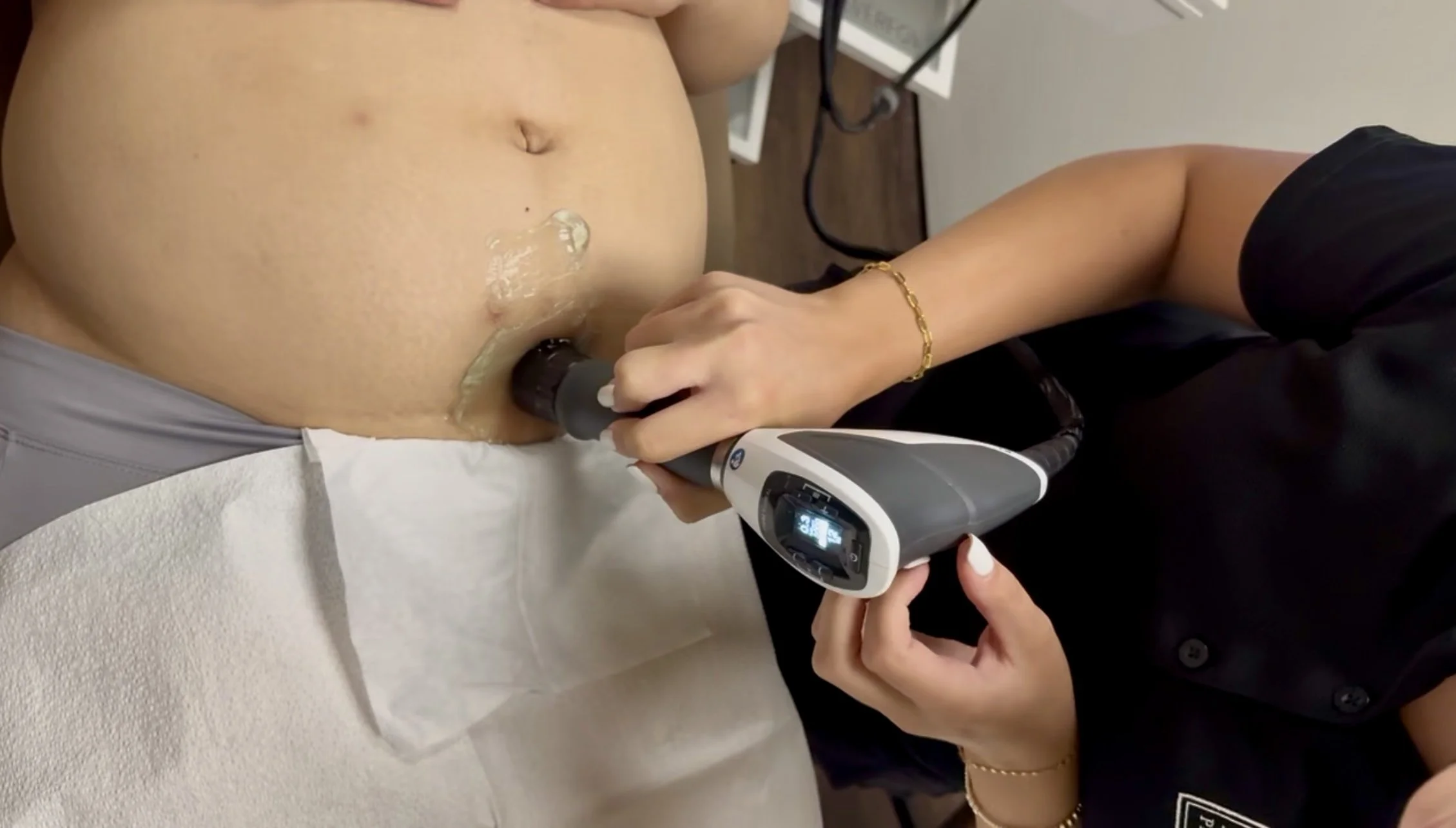
Shockwave Therapy for 20+ year old C-section scar: Resulted in relief from chronic back pain, and improved bladder urgency and frequency.
Why Do I Still Have a C-Section Shelf or Belly Pooch Years After Giving Birth?
A C-section is major abdominal surgery, and the healing process involves much more than the visible incision.
As the body repairs the surgical area, it produces collagen to form scar tissue. This is a normal and necessary part of recovery.
However, scar tissue doesn't always have the same flexibility or mobility as the surrounding tissues.
In some women, the scar becomes less mobile, creating an area that feels tight, thick, or tethered to the deeper tissues.
When the surrounding skin and soft tissue move over an area that is less mobile, a visible indentation or fold can sometimes develop.
This is one possible contributor to what many women call the C-section shelf, C-section pooch, or mommy tummy.
But scar tissue is only one piece of the picture.
Other factors that can contribute to a persistent postpartum belly include:
Scar tissue restrictions: Reduced mobility around the incision can contribute to pulling, indentation, and uneven abdominal contours.
Fascial restrictions: Changes in the connective tissue surrounding the abdomen may influence how the skin and deeper tissues move.
Diastasis recti: Changes in the separation and tension of the abdominal muscles can contribute to bulging or difficulty controlling abdominal pressure.
Abdominal muscle dysfunction: Pregnancy and surgery may affect how effectively the deep core muscles coordinate during movement.
Loose or hanging skin: Skin stretched during pregnancy may not fully return to its previous elasticity.
Changes in fat distribution: Subcutaneous fat can contribute to a fold or overhang above the incision.
Posture and breathing mechanics: How you hold your body, breathe, and manage pressure through the abdomen can affect the appearance of your belly during different activities.
For many women, several of these factors are present at the same time.
This is why another ab workout, endless crunches, or losing five more pounds may not address the specific reason your lower belly still looks different.
And it's exactly why understanding the underlying cause matters before choosing a treatment.
How to Get Rid of a C-Section Shelf Without Surgery
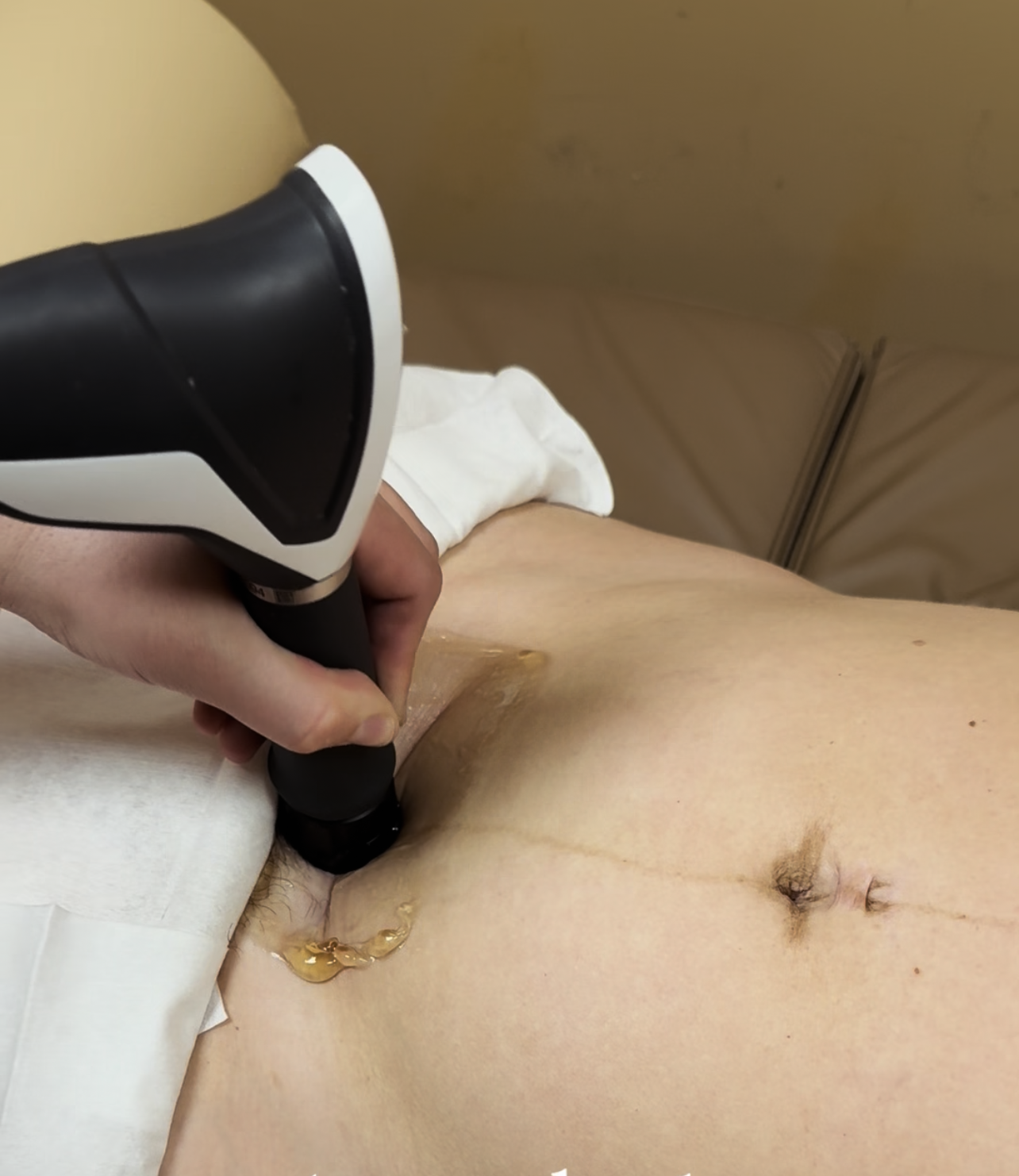
Applying Shockwave Therapy on a 2 month postpartum C-Section Scar. Resulted in significant reduction in low back pain, pelvic floor heaviness and improved overall appearance of the scar with little to know overhang.
If you've searched Google for "how to get rid of a C-section shelf," you've probably come across everything from abdominal exercises and scar massage to creams, shapewear, and surgical procedures.
The most appropriate treatment depends on what's actually contributing to the shelf.
If the appearance is related to restricted scar tissue, improving the mobility of that tissue may help reduce some of the pulling or indentation around the incision.
If diastasis recti or poor abdominal muscle coordination is contributing to the bulge, targeted rehabilitation may improve abdominal function and how the belly looks during movement.
When the concern is primarily significant excess skin or subcutaneous fat, physical therapy and scar treatment are unlikely to eliminate the overhang.
There isn't one treatment that addresses every type of C-section belly.
At Arancia Physical Therapy, we evaluate the scar, surrounding fascia, abdominal wall, posture, breathing mechanics, and pelvic floor to better understand the factors that may be contributing to your concerns.
For women with restricted scar tissue, one treatment we may incorporate is shockwave therapy.
What Is Shockwave Therapy for C-Section Scars?
Shockwave therapy, also known as extracorporeal shockwave therapy (ESWT), is a noninvasive treatment that delivers acoustic pressure waves into targeted tissues.
These waves create mechanical stimulation within the tissue, which may influence biological processes involved in tissue repair and remodeling.
Research has explored shockwave therapy for several types of scars, with some studies suggesting potential benefits for scar flexibility, discomfort, and tissue characteristics.
At Arancia Physical Therapy, we use shockwave therapy as part of our regenerative care approach when clinically appropriate.
Unlike treatments that focus exclusively on the surface of the skin, shockwave therapy is designed to stimulate tissues beneath the surface.
For C-section scars, potential treatment goals may include improving tissue mobility, reducing discomfort, and supporting the rehabilitation of restricted scar tissue.
And when scar tethering contributes to an uneven abdominal contour, improving tissue mobility can also influence how the surrounding area looks.
5 Ways Shockwave Therapy May Help After a C-Section
1. Improving Scar Tissue Mobility
A scar can look completely healed on the outside while still feeling tight or restricted underneath.
Some women notice that the skin around their incision doesn't move freely, or that the area feels stuck when they stretch, twist, or stand upright.
Shockwave therapy may help improve certain scar characteristics, including pliability and comfort.
When combined with hands-on myofascial release, treatment can focus on improving movement through the scar and surrounding abdominal tissues.
2. Addressing the Appearance of a C-Section Shelf or Belly Pooch
This is one of the biggest concerns women bring to us.
They may feel strong, exercise regularly, and maintain a healthy weight, yet still notice a fold or indentation directly above their C-section incision.
If restricted scar tissue is contributing to that indentation, improving tissue mobility may help the surrounding tissues move more freely.
In some individuals, this could lead to a smoother-looking abdominal contour.
The distinction is important. Shockwave therapy does not remove abdominal fat or reliably tighten excess skin. Changes in appearance are most plausible when treatable tissue restrictions are contributing to the contour.
3. Supporting Tissue Remodeling
Scar tissue is made largely of collagen, and the organization of that collagen can influence how flexible the tissue feels.
Shockwave therapy has been studied for its effects on cellular signaling, local circulation, and tissue remodeling.
These mechanisms may help explain why some scars become more comfortable or pliable following treatment.
Although these findings are encouraging, the amount of improvement varies, and more research is needed to establish optimal protocols for C-section scar rehabilitation.
4. Reducing Pulling, Tightness, and Sensitivity
Some women experience pulling across their lower abdomen when standing tall, reaching overhead, exercising, or even taking a deep breath.
Others notice tenderness, sensitivity, or discomfort around their incision long after surgery.
Scar restrictions can sometimes contribute to these symptoms.
Shockwave therapy may be one option for addressing certain scar-related symptoms, particularly when combined with individualized rehabilitation.
5. Helping You Reconnect With Your Abdominal Wall
Following a C-section, some women struggle to feel or coordinate their lower abdominal muscles.
This can be related to several factors, including altered sensation, pain, muscle weakness, and changes in motor control.
Improving scar comfort and mobility may make it easier to participate in abdominal rehabilitation.
At Arancia, we combine appropriate tissue treatment with movement retraining to help improve how the abdomen, diaphragm, and pelvic floor work together.
Can Shockwave Therapy Tighten Loose or Hanging Skin After a C-Section?
If your primary concern is hanging skin or a noticeable overhang above your C-section scar, it's important to understand the difference between loose skin and restricted scar tissue.
Loose skin develops when the skin has stretched and does not fully return to its previous elasticity.
Scar tethering occurs when tissue around the incision is less mobile than the surrounding area.
These can look similar, and they can also occur together.
If scar tissue is pulling on the surrounding abdomen, improving its mobility may change the way that area moves and potentially how it looks.
Significant excess skin generally requires different treatment considerations.
This is why we never assume that every C-section shelf has the same cause.
Our goal is to identify which factors may be responsive to conservative treatment and help you understand what changes are realistic.
Your C-Section Scar May Be Connected to Your Back, Core, and Pelvic Floor
One of the most overlooked parts of C-section recovery is how pregnancy and abdominal surgery can influence the entire body's movement and pressure-management system.
Your abdominal wall doesn't work independently.
It coordinates with your diaphragm, pelvic floor, rib cage, spine, and hips to support movement, breathing, and everyday activities.
Pregnancy can change the demands placed on this system, and abdominal surgery adds another layer to recovery.
Some women experience a combination of symptoms, including:
Chronic lower back or hip discomfort
Difficulty activating their abdominal muscles
Abdominal bulging during exercise
Urinary leakage or urgency
Pelvic pressure or heaviness
Constipation or difficulty coordinating bowel movements
Pain with intimacy
Pulling or discomfort around the C-section scar
These symptoms have multiple possible causes, and they aren't necessarily caused by the scar itself.
But when abdominal restrictions, altered breathing patterns, and pelvic floor dysfunction occur together, addressing the whole system may be more beneficial than focusing on one isolated area.
Your abdomen, back, and pelvic floor work together every day. Your treatment plan should consider that relationship.
Why Arancia Physical Therapy Takes a Whole-Body Approach
At Arancia Physical Therapy, we don't believe that evaluating a C-section scar should begin and end with the incision.
We look at how the body moves, how the abdominal tissues respond to pressure, and whether restrictions elsewhere may be contributing to your symptoms.
We don't automatically assume that the most visible area is the only area that needs attention.
For some women, scar treatment is an important component of recovery. For others, the biggest opportunities for improvement involve abdominal strength, breathing mechanics, pelvic floor coordination, or other factors.
Our approach is individualized because no two postpartum bodies recover in exactly the same way.
Can a C-Section Scar Still Be Treated 10, 20, or 30 Years Later?
Absolutely. A C-section scar doesn't have to be new to benefit from evaluation and potentially appropriate treatment.
Many women assume that once their children are older, they've missed their opportunity to address lingering scar tightness, sensitivity, or abdominal dysfunction.
But mature scars can still have restrictions that affect tissue mobility and comfort.
Even years or decades after surgery, scar rehabilitation may help some women improve movement and reduce discomfort.
The amount of improvement depends on the scar, surrounding tissues, medical history, and treatment goals.
A scar that has been present for 20 years will not necessarily respond the same way as one that healed six months ago, and cosmetic changes are not guaranteed.
Still, the age of your scar alone doesn't mean it's too late to explore treatment.